Blog

  • Youth and Family Peace Day 2025

    By its third year, an annual event either finds its character or it fades. The third annual Youth and Family Peace Day, held on Saturday 8 November 2025 at the Due Drop Event Centre, Sir Robinson Conference Centre, Manukau, found its character — and then some.

    More than 150 participants from across Auckland’s faith and cultural communities gathered under the conviction that had animated the event since its inaugural gathering in 2023: that family building is nation building, and that the most durable foundations of peace are laid not in policy documents or diplomatic agreements, but in the daily life of families who choose to love well.

    Opening Ceremony

    The programme commenced at 1:00 pm with an opening ceremony that carried the warmth and spiritual grounding that has become a hallmark of UPF New Zealand’s events.

    A karakia by Apotoro Shannon Leilua of the Ratana Church opened the gathering — grounding the afternoon in the spiritual inheritance of Aotearoa. The New Zealand national anthem followed, sung together by the assembled community, before Mr. Geoffrey Fyers, UPF NZ Secretary-General, and Mr. Amon Watanabe of FFWPU Youth formally welcomed the gathering and outlined the day’s programme.

    Mr. Kenji Watanabe, UPF NZ Chairman, offered opening remarks that situated the afternoon’s celebration in UPF New Zealand’s ongoing work — the National Family Day Petition, the network of Ambassadors for Peace across Aotearoa, and the conviction that communities like the one assembled at Due Drop are the living proof that a culture of peace is possible.

    Keynote: Family Building is Nation Building

    The keynote address was delivered by Mr. Ross Robertson QSC, AFP — former Deputy Speaker of the New Zealand House of Representatives, long-serving Ambassador for Peace, and one of the most trusted voices in UPF New Zealand’s community. Ross returned to the Youth and Family Peace Day stage with a message as clear and timely as ever: “Family Building is Nation Building.”

    The keynote addressed a truth that sits beneath much of the political and social turbulence of the current moment: that nations are not built primarily by governments, markets, or institutions, but by the families that form the moral and relational substrate of national life. A nation whose families are strong — where children are loved and guided, where spouses are committed and faithful, where the elderly are honoured and cared for — is a nation with reserves of resilience that no government programme can easily replicate.

    Ross spoke with the authority of a man who has spent decades in public life watching what happens when those reserves are depleted — and the conviction of someone who believes it is not too late to rebuild them.

    The LDS Church Manukau Stake added a warmly received musical performance to the opening proceedings, contributing a spirit of joy and community that set the tone for the afternoon ahead.

    A Programme Built for Community

    The afternoon programme drew on the strengths that Youth and Family Peace Day has developed across three years: cultural performances that showcase Auckland’s extraordinary diversity; exhibition tables giving community organisations the opportunity to share their resources; and the informal conversations that happen in corridors and over shared food — often the most meaningful part of any gathering.

    The event brought together participants from Pacific Island, South Asian, East Asian, Māori, and mainstream New Zealand communities — a cross-section of Auckland that rarely finds itself in the same room, and that discovers, each time it does, more common ground than difference.

    Three Years and Growing

    Youth and Family Peace Day has now become one of UPF New Zealand’s most significant annual contributions to Auckland’s community life. From the inaugural event in 2023 — which drew more than 350 people and established the template — to the deepened programme of 2024, and now to the 2025 gathering with its third cohort of participants, the event has grown into something the community can count on.

    Planning is already underway for Youth and Family Peace Day 2026. UPF New Zealand looks forward to welcoming an even broader cross-section of Auckland’s families, faith communities, and civic leaders to what has become one of the most distinctive days in the organisation’s calendar — and one of the clearest expressions of the conviction that drives everything UPF New Zealand does: that peace begins at home.
  • Monthly Meeting — June 2025 Report

    On the last Saturday of June 2025, members and Ambassadors for Peace gathered at the Peace Embassy, 24 St Stephens Avenue, Parnell for UPF New Zealand’s monthly meeting — a regular rhythm of reflection, review, and planning that keeps the organisation’s work grounded and forward-looking throughout the year.

    The agenda reflected the full breadth of UPF New Zealand’s commitments: from global geopolitics to local community events, from the practical logistics of upcoming programmes to the strategic questions of how to grow the National Family Day Petition campaign. It was a full morning — and a productive one.

    1. UPF Statement on the Escalation Between Israel and Iran

    The meeting opened with a topic of international urgency: the recent escalation of tensions between Israel and Iran. The Middle East had once again become a focal point of global anxiety, with the potential for broader regional conflict weighing on the minds of leaders and communities worldwide.

    UPF New Zealand reaffirmed its dedication to dialogue, peaceful resolution, and the importance of upholding international law and human rights in all circumstances. Members reviewed and endorsed a draft statement emphasising the need for restraint and constructive diplomatic engagement — and expressing UPF’s support for all efforts aimed at de-escalation and lasting peace in the region.

    The statement was grounded in a conviction that UPF holds consistently across all conflicts: that wars begin with the breakdown of relationship — between individuals, between communities, between nations — and that the path back to peace runs through the same territory. Dialogue is not naivety. It is the only road that actually leads somewhere.

    2. UN Family Day Event Review

    Members turned with warmth to a review of the UN International Day of Families event held the previous month. The gathering at Kelston Community Centre had been a success by any measure: around 60 attendees, a thoughtful programme, inspired presentations from Mrs. Anne Degia-Pala QSM and Chairman Kenji Watanabe, and musical performances that had lifted the afternoon.

    Positive feedback from participants was shared — and the committee discussed ideas for building on this year’s programme in 2026. The question of venue, of outreach, and of how to deepen the partnership with organisations like IKPACT and FFWPU Youth was explored with enthusiasm. Each iteration of the UN Family Day event has grown more connected and more reflective of the community it serves.

    3. Planning for UN International Day of Peace — 21 September 2025

    Early planning discussions were held for UPF New Zealand’s commemoration of the UN International Day of Peace, scheduled for 21 September 2025. Ideas under consideration included collaborative prayer for peace and reconciliation with local faith and community groups — an acknowledgement that in 2025, with conflicts active in multiple regions of the world, a day set apart for reflection and recommitment to peace carries particular weight.

    The committee agreed to reach out to the various faith and ethnic communities with whom UPF New Zealand has established relationships, inviting them to participate in what it is hoped will be a gathering that reflects the full diversity of Auckland’s community.

    4. Youth and Family Peace Day — 8 November 2025

    Early planning for the third annual Youth and Family Peace Day — scheduled for Saturday 8 November 2025 — was also discussed. Building on the success of the previous two events (350+ attendees in 2023 and 300+ in 2024), the committee reaffirmed the importance of the event’s core vision: empowering families, fostering a culture of unity and mutual respect, and giving young people a genuine stake in the peace they are being asked to build.

    The discussion touched on venue logistics, programme development, and the question of how to expand the exhibition element — which has consistently been one of the most popular features of the event, giving community organisations the opportunity to share their resources and connect with new audiences.

    National Family Day Petition Promotion

    The meeting concluded with a review of strategies for promoting the National Family Day Petition — the ongoing campaign to establish 11 November as a dedicated national family day in New Zealand. Key actions discussed included:

    • Increased outreach through social media platforms, including personal stories about the positive impact of strong family bonds
    • Collaboration with community organisations and schools to broaden the petition’s reach
    • Engaging local politicians and community leaders as vocal supporters of the campaign
    • Hosting informational sessions and Q&A forums in different parts of Auckland

    The meeting concluded with a renewed sense of purpose — and the particular kind of energy that comes from a group of people who share a vision and have the plans to pursue it. UPF New Zealand meets monthly at the Peace Embassy. All Ambassadors for Peace and interested community members are welcome to attend.

  • UN International Day of Families 2025

    UN International Day of Families 2025

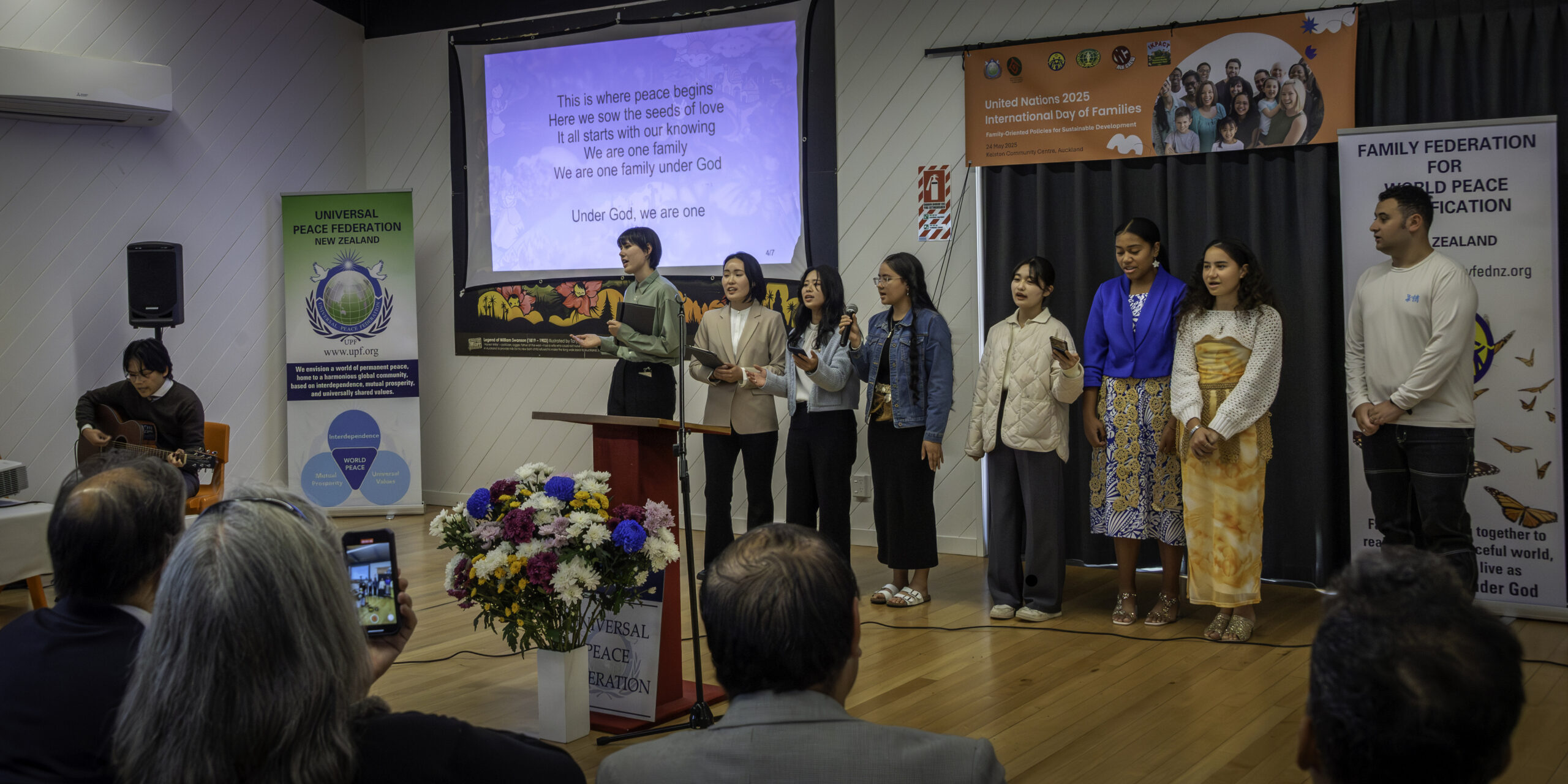
    On Saturday 24 May 2025, the Kelston Community Centre — Te Pae o Kura, Hikurangi in West Auckland became the site of UPF New Zealand’s annual commemoration of the United Nations International Day of Families. Around 60 people attended — drawn from across Auckland’s diverse faith and community networks — for an afternoon centred on the 2025 UN theme: “Family-oriented Policies for Sustainable Development.”

    The choice of Kelston as the venue reflected UPF New Zealand’s ongoing commitment to taking its events into different parts of the city — meeting people where they are, rather than always drawing them to a central location. West Auckland’s vibrant multicultural community was a fitting setting for an event that celebrates the family as the most universal of human institutions.

    Opening in the Spirit of Aotearoa

    The event opened with a prayer by Apostle Shannon Leilua of the Ratana Church — grounding the afternoon’s gathering in the spiritual values of Aotearoa and the Māori tradition of beginning communal occasions with karakia. It was a fitting start: the Ratana Church, rooted in the prophetic faith of New Zealand’s tangata whenua, has been a consistent partner in UPF New Zealand’s work, lending its spiritual voice to events across the year.

    Geoffrey Fyers, Secretary General of UPF New Zealand, then delivered the UPF statement on the International Day of Families — articulating the organisation’s conviction that the family is not merely a social unit, but the primary institution through which human beings learn to love, to serve, and to belong.

    Family-oriented Policies for Sustainable Development

    The UN theme for 2025 resonated deeply with UPF New Zealand’s ongoing National Family Day Petition campaign — a campaign calling on the New Zealand Government to recognise 11 November as a dedicated national family day. The connection between family-oriented policy and sustainable development is, for UPF, a deeply held conviction: that a society which invests in strong families is investing in everything else worth building.

    Sustainable development, in this understanding, is not primarily a matter of economic growth or environmental management — though it includes both. It is, at its foundation, a matter of human flourishing: of communities where people are loved and nurtured from birth, where the next generation is raised with values of responsibility and care, and where the bonds of family extend outward into a society of genuine mutual support.

    Presentations

    The programme featured presentations from two distinguished community leaders:

    • Mrs. Anne Degia-Pala, QSM — a community leader recognised with the Queen’s Service Medal for her years of service to New Zealand communities, whose perspective on the role of strong families in community resilience carried the weight of lived experience
    • Mr. Kenji Watanabe — Chairman of UPF New Zealand, who spoke on the role of families in building peaceful communities and on UPF’s vision for a New Zealand that honours family as the foundation of national life

    Cultural Performances

    The afternoon was enriched by performances that reflected the cultural diversity of UPF New Zealand’s community:

    • IKPACT members Suresh Trivedi and Shashi — offering a musical contribution from the Indian Kiwi community that brought warmth and energy to the afternoon
    • A choral presentation by FFWPU Youth — young members of the Faith Federation singing together in a performance that embodied the event’s theme: that families nurture the next generation, and the next generation carries the values of peace forward

    A Community That Keeps Showing Up

    Around 60 people came to Kelston Community Centre on a Saturday afternoon in autumn. They came from different suburbs, different cultural backgrounds, and different faith traditions. They sat together, listened together, and were fed — literally and figuratively — by what they shared.

    UPF New Zealand is grateful to the Kelston Community Centre for hosting the event, to every presenter and performer who contributed, and to every person who made the journey to be there. The UN International Day of Families is observed every year on 15 May. Our commemoration came a week later, but it arrived with the same conviction: that families matter, that policies which support them matter, and that communities which gather to say so are doing something genuinely important.

  • World Summit 2025: New Zealand Delegates in Seoul

    In April 2025, the eyes of the global peacebuilding community turned to Seoul, South Korea. The World Summit 2025 — hosted at the Lotte World Hotel from 11 April — gathered political and religious leaders, scholars, and civil society representatives from 117 nations, under a theme that captured both the gravity of the current global moment and the urgency of its call to action: “Contemporary Challenges to World Order: Establishing a New Era of Peace and Prosperity.”

    For UPF New Zealand, the summit was an occasion of particular pride: two distinguished delegates from one of New Zealand’s most historically significant indigenous Christian movements — the Ratana Church — attended as representatives of the Pacific nation, carrying the voice of Aotearoa into one of the most significant international peace gatherings of the year.

    New Zealand at the Summit

    UPF New Zealand was represented by:

    • Tumuaki Manao Tamou — President of the Ratana Church
    • Mr. Kamaka Manuel — Chairman of the Ratana Church

    Their participation reflects the deep and longstanding relationship between UPF New Zealand and the Ratana Church — a relationship built on shared values of family, community, and the spiritual foundations of peace. The Ratana Church, founded in 1918 and rooted in the prophetic vision of Tahupotiki Wiremu Ratana, has been a significant force in Māori spiritual and political life for more than a century. Its presence at a global summit on peace underlined the Pacific region’s rightful place in international conversations about the world’s future.

    Opening the Summit: A World at a Crossroads

    The summit’s opening ceremony set a tone of clear-eyed urgency. Dr. Charles S. Yang, Chairman of UPF International, welcomed the assembled delegates with a sobering assessment of the current security situation — particularly on the Korean Peninsula, which has remained divided for 80 years since the end of World War II, in the same year that the United Nations was founded.

    “Without peace on the Korean Peninsula,” Dr. Yang said, “there can be no peace in Northeast Asia. Nor can we achieve world peace.” He called for North and South Korea to resolve their hostile confrontation and create a cooperative relationship of mutual dependence and coexistence — and for the international community to support that process with consistent, principled engagement.

    The 80th anniversary of the United Nations, observed in 2025, gave the summit additional significance. The UN was founded with the goal of preventing the catastrophic wars that had devastated the world in the first half of the 20th century. Eight decades on, that goal remains unfinished — and the question of how to renew and strengthen the institutions of international peace was a central thread running through the summit’s discussions.

    Faith, Leadership, and Global Crises

    Dr. Paula White-Cain, Senior Advisor to US President Donald Trump for the newly created White House Faith Office, spoke to the growing recognition of faith’s role in diplomacy and public policy. She noted that more than 1,000 faith leaders from diverse religions had visited the White House since January 20 to help shape policy, conduct faith diplomacy, and defend religious liberty — a striking indication of the renewed interest in what faith communities can contribute to the work of governance and peacebuilding.

    The summit addressed two overarching crises facing the global community:

    • The contemporary climate crisis — understood not merely as an environmental issue, but as a symptom of humanity’s broken relationship with the natural world and with one another
    • Humanitarian crises including hunger, displacement, and the ongoing suffering caused by armed conflicts across multiple continents

    These crises, the summit argued, are not separate problems demanding separate solutions. They are interconnected expressions of a deeper disorder — a world that has yet to find the shared values and the institutional architecture needed to live in genuine peace and mutual prosperity.

    The Opening of Cheon Won Gung

    Summit participants were also invited to attend the opening of the Cheon Won Gung on 13 April — a new Interreligious and International Peace Palace built on the slopes of Cheonseong Mountain at Lake Cheongpyeong, South Korea. The palace spans 125,000 square metres with 82,000 square metres of floor area, and is designed as a global centre for peace education, cultural exchange, and interreligious dialogue.

    For delegates from New Zealand, the scale of the facility was a tangible expression of UPF’s long-term vision — a physical home for the kind of international, interfaith work that has been at the heart of the organisation’s mission since its founding in 2005.

    A Pacific Voice in a Global Conversation

    UPF New Zealand is proud to have contributed a Pacific voice to this global gathering. The presence of Tumuaki Manao Tamou and Mr. Kamaka Manuel in Seoul was a reminder that the Pacific region — so often spoken about in international forums rather than heard from — has its own wisdom, its own perspective, and its own stake in the future of world peace.

    The lessons and connections of the World Summit 2025 will be channelled back into UPF New Zealand’s ongoing work across Aotearoa — in the monthly meetings at the Peace Embassy, in the annual events that bring Auckland’s communities together, and in the quiet, daily work of building a culture of peace one relationship at a time.

  • National Family Day Petition: Relaunching the Campaign

    Eleven eleven. The date carries history in New Zealand — and in much of the world. At the eleventh hour of the eleventh day of the eleventh month in 1918, the guns of the First World War fell silent. Armistice Day has been remembered ever since as a day of gratitude, grief, and the stubborn human insistence on peace.

    For UPF New Zealand, 11 November holds an additional meaning — one that does not diminish the solemnity of remembrance, but deepens it. The organisation has spent years building the case that this date should become Aotearoa’s National Family Day: a day to affirm that the foundations of lasting peace are laid not in battlefields or peace conferences, but in the families where the next generation learns to love, to serve, and to live for others.

    In early 2025, UPF New Zealand officially relaunched the National Family Day Petition — with renewed energy, new outreach strategies, and a broader community campaign that invites all of Aotearoa to get involved.

    Why a National Family Day?

    The question deserves a direct answer. New Zealand already recognises a wide range of national commemorations and celebrations. What would a National Family Day add?

    UPF New Zealand’s answer is grounded in a conviction about the relationship between family strength and national wellbeing. Strong families produce resilient children, connected communities, and a society better able to navigate the pressures of a changing world. Conversely, family breakdown — whatever its causes — contributes to a cascade of social challenges: loneliness, educational disengagement, mental health struggles, and the erosion of the community bonds that hold us together in hard times.

    A National Family Day would not, by itself, build stronger families. But it would send a signal — a statement of national values — that families matter to New Zealand, that the work of building them is honoured, and that the Government and the community stand behind the men and women doing that work every day.

    As Chairman Kenji Watanabe has written, the proposed National Family Day reflects a vision for New Zealand grounded in four values that resonate deeply with both Māori and Pacific culture:

    • Whanaungatanga — strengthening bonds of relationship between people, across cultural and generational lines
    • Kaitiakitanga — caring responsibly for one another and for the natural world we share
    • Manaakitanga — supporting communities with dignity, generosity, and genuine hospitality
    • Kotahitanga — uniting across cultures, faiths, and backgrounds toward a shared purpose

    100 Days of Serving Community

    Alongside the petition relaunch, UPF New Zealand announced a complementary initiative: the “100 Days of Serving Community” campaign — a three-month programme inviting individuals, families, and organisations to take concrete actions of service in their own neighbourhoods and communities.

    The proposed activities are deliberately accessible:

    • Environmental clean-ups in local parks, coastlines, and public spaces
    • Supporting local food shelters, community centres, and social services
    • Organising family activities that bring communities together across cultural lines
    • Social media sharing with the theme: “Build a New Zealand that honours families”

    The 100 Days campaign reflects UPF New Zealand’s conviction that the petition is not merely a legal or political exercise — it is the visible tip of a much larger cultural project. The goal is not just a date on the calendar, but a shift in the values that shape how New Zealand thinks about family, community, and the common good.

    Signature Campaign

    The SNS National Family Day Signature Campaign launched in early 2025, with targeted outreach through social media, community organisations, and local leaders. UPF New Zealand is calling on like-minded politicians, community influencers, faith leaders, and everyday Kiwi families to lend their voices — and their signatures — to the cause.

    To sign the petition and add your voice, contact UPF New Zealand at secretariat@upfnz.org or attend one of our monthly community meetings at the Peace Embassy in Parnell, Auckland. Together, we can build a New Zealand that honours families — and in doing so, honour the deepest values of Aotearoa.

  • End of Year Celebration 2024

    There is a particular quality to the last gathering of the year. The urgency of the programme calendar has passed. The formality softens. People who have worked alongside each other through events, meetings, and initiatives find themselves simply together — sharing food, sharing stories, and finding in each other’s company the renewal that makes the next year’s work possible.

    On Saturday 14 December 2024, more than 50 people gathered at the Peace Embassy, 24 St Stephens Avenue, Parnell for UPF New Zealand’s annual End of Year Celebration. The format was a potluck dinner — everyone contributing a dish from their own cultural tradition, and the table becoming, in miniature, a picture of the community UPF New Zealand has spent the year building.

    The evening ran from 4:00 pm to 7:00 pm and brought together Ambassadors for Peace, family members, longtime supporters, and new friends — a gathering that was at once a farewell to 2024 and a quiet anticipation of 2025.

    A Year Worth Celebrating

    Kenji Watanabe, Chairman of UPF New Zealand, and Geoffrey Fyers, Secretary General, offered thanksgiving reflections on the year — a year that, by any measure, had been one of UPF New Zealand’s most active and impactful.

    The highlights were many:

    • The second Youth and Family Peace Day at the Due Drop Events Centre in November — welcoming over 300 people under the theme “Communities United for Fostering Peace, Strengthening Families, and Empowering Youth”
    • The UN International Day of Peace commemoration at Te Tuhi Centre of Art, Pakuranga, marking the 25th anniversary of the UN Declaration on a Culture of Peace
    • The UN International Day of Families at Te Tuhi Art Centre in May, featuring an interfaith panel and cultural performances from across Auckland’s communities
    • The co-organisation of the 2024 World Sport Fishing Tournament in the Waitemata Harbour — 71 teams from 15 nations, with 900 kilograms of the catch donated to a South Auckland marae
    • Continued momentum for the National Family Day Petition, with growing community support for the establishment of 11 November as a dedicated national family day

    Behind each of these events lay months of planning, partnership-building, and the quiet, unglamorous work of community organisation. The end-of-year dinner was a chance to acknowledge all of that — and the people who had made it possible.

    Welcoming a New Ambassador for Peace

    The evening included a formal ceremony that stood as one of its most meaningful moments: the recognition of Ms. Reeta Arora as a newly appointed Ambassador for Peace.

    The title of Ambassador for Peace carries genuine significance within the UPF community. It is not an honorary title bestowed at a distance — it is a commitment to live by the values of living for the sake of others: promoting universal values, strong family life, and interreligious cooperation in one’s own sphere of influence. Ms. Arora joins a growing network of Ambassadors for Peace across Aotearoa who are carrying that commitment into their communities, their professions, and their families.

    Looking Ahead to 2025

    As the evening moved toward its close, conversation turned naturally to the year ahead. 2025 would bring major milestones: the World Summit 2025 in Seoul in April; the UN International Day of Families in May; and the third annual Youth and Family Peace Day in November. The National Family Day Petition campaign would be relaunched with new energy and new outreach strategies.

    UPF New Zealand’s work continues across six areas of focus: interfaith peacebuilding, peace and security, UN relations, marriage and family, education and human development, and humanitarian and youth programmes. Each area connects to the others. Each is grounded in the same conviction that has driven UPF New Zealand’s work from the beginning: that family building is nation building, and that the foundations of lasting peace are laid not in parliaments or peace conferences, but in the daily life of communities that choose to live for one another.

    The potluck dishes were finished, the conversations were still going, and the Peace Embassy was filled — as it is at its best — with the sound of people who like each other, gathered around a shared purpose. It was a good ending. And the beginning of something even better.

  • Youth and Family Peace Day 2024

    It is one thing to hold an event. It is another to hold it twice — and watch it grow. On Saturday 9 November 2024, the second annual Youth and Family Peace Day opened its doors at the Due Drop Events Centre in Manukau, South Auckland, and over 300 people came to be part of it.

    The venue was the same as the inaugural event in 2023 — a deliberate choice. Due Drop has become the home of Youth and Family Peace Day, and its familiar halls carried the memory of what had been built there a year earlier, even as the 2024 programme brought new energy, new partners, and a new theme: “Communities United for Fostering Peace, Strengthening Families, and Empowering Youth.”

    Opening the Day

    The opening programme began at 11:00 am in the main hall. The day started, as it had in 2023, with a karakia — this year offered by Tokorima Aperahama, Ratana Church youth representative, who has become a familiar and beloved presence at UPF New Zealand events. His family joined him in a hymn that grounded the morning in the spiritual values of Aotearoa.

    Ruth Cleaver, a senior member of UPF New Zealand and former President of the Auckland Interfaith Council, served as MC for the opening session — acknowledging the partner organisations whose presence filled the exhibition hall next door with information, resources, and community goodwill.

    Kenji Watanabe, Chairman of UPF New Zealand, and Geoffrey Fyers, Secretary General, delivered opening remarks and presented the Resolution of the National Family Day Petition — reaffirming the campaign’s call for the New Zealand Government to recognise 11 November as a dedicated national family day, and inviting the assembled community to add their voices to the movement.

    Distinguished Guests

    The event was again honoured by the presence of distinguished guests whose welcoming remarks lent the occasion civic weight and warmth:

    • Hon. Jenny Salesa, Member of Parliament — returning for her second consecutive Youth and Family Peace Day, her presence a sign of Parliament’s growing recognition of UPF New Zealand’s contribution to Auckland’s community life
    • Mr. Keu Mataroa, Consul General of the Cook Islands — representing the Pacific community’s stake in the values of family and peace that the event embodies
    • Mr. Joe Fatuleai, Stake President of Redoubt, The Church of Jesus Christ of Latter-day Saints — bringing the voice of one of South Auckland’s most active faith communities

    Keynote: The Family as the School of Love

    The keynote address was delivered by Greg Stone, Secretary General of UPF Oceania — returning to the Youth and Family Peace Day stage for the second year running. His keynote built on the theme he had introduced in 2023, deepening the community’s understanding of the relationship between family life and societal peace.

    Greg’s central message was one that his audiences find both challenging and liberating: “The family is not just the building block of society — it is the school where we learn to love, to forgive, and to live for others.”

    This is a claim with practical implications. If the family is where we learn to love — or fail to — then the health of families is not a private matter. It is the most public of all concerns, because every family that succeeds in raising children with the capacity to love and serve is making a contribution to the peace of the society those children will inhabit and lead.

    The Exhibition Hall: Resources for Real Life

    One of the most distinctive features of the 2024 Youth and Family Peace Day was the expanded exhibition hall, where faith groups, social service organisations, government institutions, and NGOs set up information tables offering practical resources on:

    • Healthy marriages and relationship skills
    • Parenting with purpose and positive family values
    • Youth leadership and character development
    • Interfaith cooperation and community belonging

    Partner organisations from across Auckland — spanning Pacific Island churches, South Asian community groups, mainstream social services, local government, and civil society — contributed information, performances, and presentations throughout the day. The exhibition hall was, in many ways, the most democratic part of the event: a space where visitors could wander at their own pace, pick up a resource that spoke to their situation, and have a conversation that might change something for them.

    A Growing Movement

    More than 300 people came to the Due Drop Events Centre on 9 November 2024. They came from different parts of Auckland, different cultural backgrounds, different faith traditions, and different generations. They stayed for different lengths of time and took away different things — but they all came.

    The steady growth of Youth and Family Peace Day — from 350+ across a full-day programme in 2023 to 300+ through a refined and deepened programme in 2024 — reflects not a decline, but a maturing: an event that has found its form and is growing in depth as it grows in reach. The third annual Youth and Family Peace Day is already being planned for November 2025, and UPF New Zealand is looking forward to welcoming even more families, young people, and community leaders to what has become one of Auckland’s most distinctive annual peace gatherings.

  • UN International Day of Peace 2024

    On Saturday 21 September 2024, UPF New Zealand joined communities around the world in marking the United Nations International Day of Peace. The commemoration was held at the Te Tuhi Centre of Art in Pakuranga, East Auckland — a space well suited to an event that combined civic ceremony, cultural celebration, and quiet reflection. At its peak, more than 80 people attended the three-hour programme.

    This year’s gathering carried particular weight. 2024 marked the 25th anniversary of the United Nations General Assembly’s adoption of the Declaration and Programme of Action on a Culture of Peace — a milestone document that reframed peace not merely as the absence of armed conflict, but as an active, lived commitment in families, communities, educational institutions, and governments. A quarter-century on, the declaration remains as urgent as the day it was signed.

    Co-Sponsorship with IKPACT

    The event was co-sponsored by UPF New Zealand and the Indian Kiwis Positive Aging Charitable Trust (IKPACT) — a partnership that reflected the multicultural character of both the event and the community it served. MC Garpreet Singh guided the programme with skill and warmth, creating an atmosphere in which distinguished guests and community members alike felt genuinely welcome.

    Distinguished Guests

    The occasion drew several notable civic figures whose presence underlined the event’s significance:

    • Hon. Jenny Salesa, Member of Parliament, who offered a congratulatory message recognising UPF New Zealand’s contribution to Auckland’s peace and interfaith community
    • Morrin Cooper, former Mayor of Howick, whose long civic career in East Auckland gave particular resonance to his presence at a Pakuranga venue
    • Ms. Adele White, Local Board Representative, who brought the voice of local government to the occasion
    • Harjit Singh, Chairman of IKPACT, who offered formal greetings on behalf of the co-sponsoring organisation

    A Culture of Peace: Diversity, Harmony, Unity

    UPF New Zealand’s presentation at the event focused on the values at the heart of a genuine culture of peace: diversity, harmony, and unity as one family of humanity. These are not slogans — they are descriptions of what UPF believes is actually possible, when communities choose to invest in the relationships and the institutions that make shared life good.

    The team shared on the importance of service learning and healthy families as the practical building blocks of a culture of peace — grounding the afternoon’s reflection in the conviction that peace is not merely a diplomatic achievement, but a daily practice cultivated in homes, schools, and communities across Aotearoa.

    Cultural Performances

    The programme was enriched by a series of performances that brought the cultural diversity of Auckland’s community vividly to life:

    • Chinese traditional and modern song and dance — showcasing the beauty and range of Chinese cultural expression, from classical forms to contemporary performance
    • Indian traditional and modern performances — bringing the colour, energy, and spiritual depth of South Asian arts to the Te Tuhi stage
    • A meditation practice — offering all attendees a shared moment of stillness and inner reflection, a reminder that peace begins within before it extends outward

    19th Anniversary of UPF’s Founding

    The event also coincided with a significant milestone in UPF’s own history. The Universal Peace Federation was founded on 12 September 2005 in New York, by Rev. Dr. Sun Myung Moon and Dr. Hak Ja Han Moon, in the presence of 1,200 leaders from around the world — including current and former heads of state. The 2024 UN Peace Day event marked UPF’s 19th anniversary: nearly two decades of working, across more than 100 countries, to build the institutional and relational foundations of lasting peace.

    As New Zealand’s own Foreign Minister, Rt Hon Winston Peters, told the UN General Assembly during September 2024: the structures of international peace need accountability and reform. UPF’s vision — of a renewed, more effective international architecture grounded in shared values and genuine interdependence — has never been more relevant.

    Peace Begins Here

    Looking at the world in September 2024 — ongoing conflict in Europe and the Middle East, tensions in the Indo-Pacific, environmental pressures bearing down on Pacific Island nations — it would be easy to feel that gatherings like this are too small to matter. UPF New Zealand’s conviction is precisely the opposite: that the culture of peace is built exactly here, in rooms like this, among people like these, choosing relationship over division and hope over despair.

    More than 80 people did that on a Saturday afternoon in Pakuranga. It was enough. And it always will be.

  • UN International Day of Families 2024

    On Saturday 25 May 2024, the auditorium of the Te Tuhi Art Centre in Pakuranga, East Auckland, became a room full of generations. Grandparents and grandchildren. Faith leaders and youth workers. Musicians from the Far North and dancers from the Chinese community. More than 60 people of all ages and backgrounds had come to celebrate the United Nations International Day of Families — and the atmosphere, from the moment the programme began, was one of genuine joy.

    UPF New Zealand’s annual commemoration of this day has become one of the most eagerly anticipated events in the organisation’s calendar — a gathering that manages to be simultaneously formal (with distinguished speakers and structured programming) and deeply human (with music, laughter, and the kind of connection that happens when people from very different worlds discover how much they have in common).

    Opening the Celebration

    MC Garpreet Singh opened the programme with warmth and good humour, before Geoffrey Fyers, Secretary General of UPF New Zealand, delivered the UPF statement on the significance of the International Day of Families. Geoffrey’s remarks situated the afternoon’s celebration in the broader global context — the United Nations’ recognition that families are the foundational unit of sustainable human development, and that policies which support strong family life are among the most important investments any society can make.

    Interfaith Panel: What Does Faith Say About Family?

    The intellectual and spiritual centrepiece of the programme was a thoughtful interfaith panel discussion that brought together four voices from four faith traditions — each reflecting on what their community believes about the family, its sacred role, and its place in the project of building a more peaceful world:

    • Dr. Zain Ali — Honorary Academic at the University of Auckland, who offered the Muslim perspective on family as a trust from God and a foundation of moral formation
    • Mr. Levi Singsam — from The Church of Jesus Christ of Latter-day Saints, sharing the LDS conviction that families are central to God’s eternal plan
    • Miss Avneet Singh — Sikh Youth representative, offering the Sikh understanding of family as the first community in which we practice the values of equality, service, and devotion
    • Mr. Amon Watanabe — of the Youth Service Programme, FFWPU, sharing a young person’s perspective on family as the school of love

    The panel was not a debate. It was a conversation — and one that revealed, beneath the genuine differences of theology and tradition, a shared conviction that the family is something sacred, something worth protecting, and something that gives meaning to the lives built within it.

    Cultural Performances

    Between the speeches and the panel, the afternoon was alive with music and performance:

    • The Ratana whanau brass band — musicians who had made the journey from Kaitaia, in the Far North, to be part of the celebration. Their presence, and the distance they had travelled, said something about how much this gathering meant to those who came.
    • An LDS Church Youth Duet — a moving musical presentation from young members of the faith community in Manukau
    • The Botany Down Chinese Association — a graceful representation of Chinese classical music and dance, bringing another layer of cultural richness to the afternoon
    • Japanese Youth Volunteers — who presented two short video presentations on family and service, offering a window into how young people across the Pacific understand their responsibility to both

    Refreshments and Community Connection

    Following the programme, attendees gathered for refreshments and informal conversation — the part of the afternoon that is, in many ways, the most important. The bonds formed over shared food and honest conversation are the actual fabric of the community UPF New Zealand is working to build. People who came as strangers left as something closer to neighbours.

    The UN International Day of Families is observed globally on 15 May each year. UPF New Zealand’s celebration came a week later, but arrived no less wholeheartedly. The conviction animating it was simple and ancient: the family is not merely a social arrangement. It is the first place where we learn to love — and in that learning, the beginning of everything else worth building.

  • 2024 World Sport Fishing Tournament

    It is not every fishing tournament that opens with a Minister of the Crown, features a symposium on international peace and security, and concludes with 90 anglers from around the world learning about traditional Māori culture at a South Auckland marae. But the 2024 World Sport Fishing Tournament was never merely a fishing competition.

    Co-organised by UPF New Zealand and the World Sport Fishing Federation (WSFF) New Zealand, the tournament ran from 8 to 12 March 2024, bringing 71 teams from 15 nations to the Waitemata Harbour — with competitors travelling from as far away as Uruguay, Kazakhstan, and Estonia to take part in what has become one of the most distinctive peace-oriented sporting events in the Pacific.

    Opening Ceremony

    The tournament opened on the evening of Friday 8 March with a ceremony at the Parnell Hotel and Conference Centre in Auckland. More than 200 people attended — a gathering that reflected the breadth of community and international connections that UPF New Zealand has built over many years.

    H.E. Keutekarakia Mataroa, Consul General of the Cook Islands, opened the ceremony formally, before Hon. Shane Jones, New Zealand’s Minister for Oceans and Fisheries, delivered keynote remarks welcoming the international competitors to Aotearoa. Minister Jones spoke to the significance of ocean stewardship as a peace-building endeavour — noting that how nations manage shared natural resources is one of the defining questions of our time in the Pacific region, where climate change, overfishing, and geopolitical competition increasingly intersect.

    Competition on the Waitemata

    The tournament itself was conducted with unique rules overseen by local and international judges and referees — a format designed to be as much about skill, patience, and respect for the ocean as about competitive sport. Five local tour boats were contracted to take the 71 teams out onto the Waitemata Harbour across multiple rounds, in what amounted to a floating international gathering of people united by a love of fishing and the sea.

    The tournament yielded approximately 1,000 kilograms of fish — a catch that, in the spirit of community service central to UPF’s mission, became something more than a sporting trophy. 900 kilograms of the catch was donated to a marae in South Auckland, to be distributed to families in need through KAI IKA, a local NGO focused on food redistribution. In a single gesture, a fishing competition became an act of community care.

    Symposium: Ocean Resources Management and Peace and Security

    On Saturday 9 March, a dedicated symposium on Ocean Resources Management and Peace and Security was held at the Parnell Hotel and Conference Centre, running from 10:30 am to 4:00 pm. This was the event within the event — the moment where the World Sport Fishing Tournament revealed its deeper purpose.

    Opening remarks were provided by H.E. Keutekarakia Mataroa, who brought the perspective of a small Pacific Island nation acutely aware of what the health of the ocean means for the survival of its people. Presenters came from Korea, Japan, Australia, and the Marshall Islands — nations with very different relationships to the Pacific Ocean, but a shared stake in its future. Local voices from LegaSea and Sea Cleaners brought the New Zealand dimension: the health of our coastal waters, the sustainability of our fisheries, and the responsibility of communities to care for what they depend on.

    UPF’s objectives for the symposium were clear: to address the management of fish resources; to explore the protection of fishing waters from the perspective of peace and security; and to work toward interdependence and mutual prosperity in the region based on common values. These are not merely environmental goals — they are expressions of UPF’s conviction that the way we treat the natural world reflects the way we treat one another.

    Cultural Exchange at the Marae

    On Monday 11 March, 90 tournament participants and staff were welcomed to the South Auckland marae that had received the tournament’s fish donation — for a day of cultural exchange that many would later describe as the highlight of their entire visit to New Zealand.

    For many of the international visitors, it was their first encounter with the living culture of Aotearoa’s tangata whenua. They were introduced to traditional Māori protocols, values, and ways of knowing — a reminder that the Pacific Ocean is not only a resource or a strategic asset, but a spiritual and cultural inheritance, tended for generations by the peoples who live alongside it.

    A Tournament with a History

    The World Sport Fishing Tournament was founded by Rev. Dr. Sun Myung Moon and Dr. Hak Ja Han Moon in 2002, with a vision of using sport as a vehicle for international friendship and environmental stewardship. Previous tournaments have been held in Japan, Korea, Taiwan, Australia, and Spain. Auckland’s hosting of the 2024 edition reflects UPF New Zealand’s growing capacity as an organisation, and the city’s standing as a hub for international peace-oriented gatherings in the Pacific.

    More than just a fishing tournament, these events have always aimed to build friendships that break down barriers between cultures and peoples through a shared love of the ocean. In Auckland in March 2024, 71 teams from 15 nations found exactly that.